
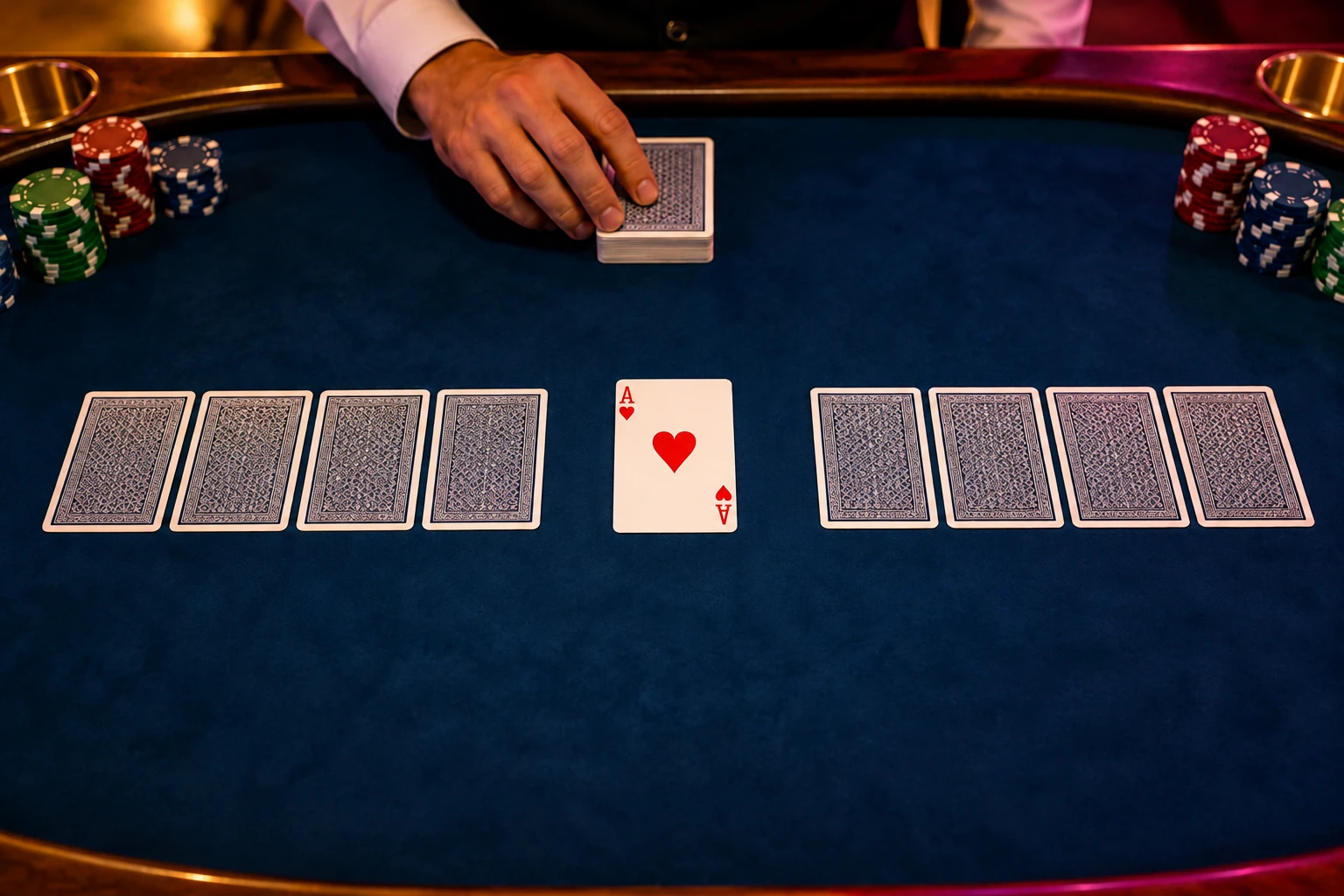
One exposed card gives the round its focus
Andar Bahar sits among the Indian card games that Slotrave carries alongside Teen Patti and Rummy. The layout is spare. A single card is turned face up and left visible on the table, and the round plays out against that card. Two labelled positions, Andar and Bahar, receive the drawn cards while the exposed card stays in view. Players who know Teen Patti will recognise the card faces and the seated dealer, yet the task here is narrower. No two hands are compared. Everything depends on whether an incoming card repeats the exposed rank.
That narrowness is the appeal. A player can follow a full round without learning a ranking order or a sequence chart. The exposed card gives the eye one fixed point, and the dealing gives it movement. The chip area and the settlement support those two elements and little else.
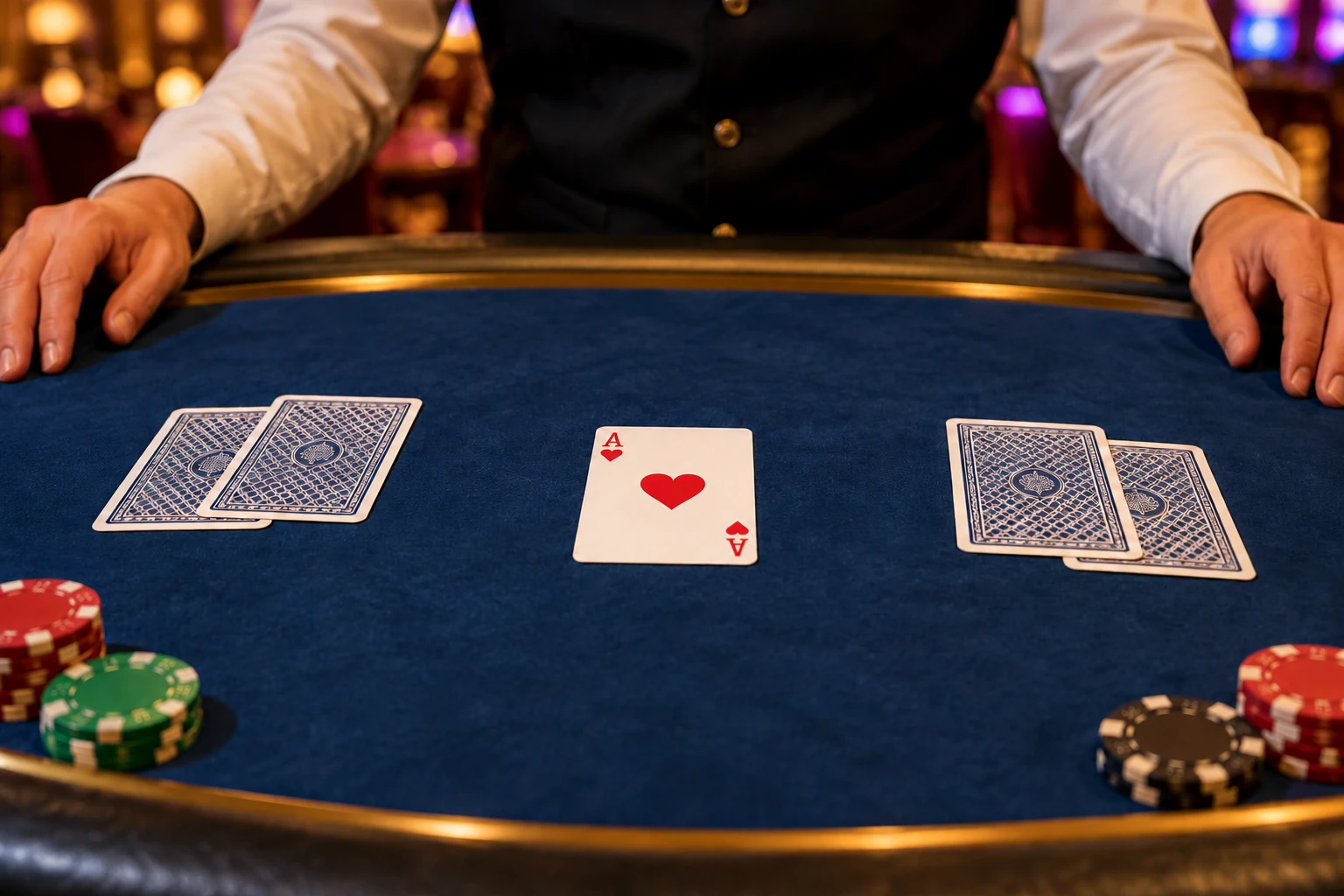
The reference card sets the rank to watch
The mechanic described in this article follows the model set out in SA Gaming’s official announcement of 5 December 2022, an external mechanism example. In that description the table uses one 52-card deck, the dealer draws a Game Card, and players predict the side on which another card of equal value appears. It is a useful illustration of the reference-card idea. Whether that specific version is available on Slotrave is unconfirmed.
The exposed card fixes a rank for the round. If it is a nine, then every nine that follows is checked against it, and suits simply indicate which card is which. A nine of spades drawn to a side completes the equal-value match in the SA game account. An eight arriving first does not. Picture the reference as an eight of diamonds, and the drawn cards as a three, a queen and later an eight of clubs. Only the last of them answers the reference. Picture cards work the same way: a king of hearts sets the target and a king of clubs completes it.
Take a second imagined table. Suppose the exposed card is a seven of hearts. The drawn cards run a jack, then a four, then a seven of clubs. Neither the jack nor the four carries the reference rank, so the imagined round continues past both. The seven of clubs arrives last, shares the rank while carrying a different suit, and answers the reference. That final card ends the imagined round. Reading the table becomes a small habit of attention. Each new card is held against one printed rank, and the answer is yes or no. The exposed card has already supplied the information that matters, and the drawn cards supply the suspense.
Two named sides carry the unfolding deal
The table shows two positions marked Andar and Bahar, and cards are dealt toward them in succession. The labels identify the two destinations, so a player should locate them rather than assume a fixed orientation. The actual dealing order belongs to the named version in play and is set out in that version’s own rules.
What holds across presentations is the sense of two destinations. The exposed card stays still while drawn cards accumulate around the two labels. Sometimes the matching rank arrives early and the round closes after a couple of draws. On other occasions the reference stays unmatched while a longer run builds on both sides. Neither shape can be forecast from the table, and the accumulated cards are simply a record of what has already been dealt.
The round ends when the first matching card lands, and the side that receives it is the side that carries the result. For a player who chose the other label, that close does not count. This is the central mechanic in its simplest form.
The Ezugi description stays separate
Ezugi’s official Andar Bahar page takes a slightly different angle on the same contest. It states that the main objective is to predict whether the Joker will fall on Andar or Bahar, and it lists side bets. That wording belongs to the Ezugi version. The Joker terminology and the side-bet list are Ezugi’s own framing and should be read in that context rather than applied to every table.
Placed side by side, the two descriptions show why the version matters. The SA Gaming announcement explains the deck, the Game Card and the equal-value match. The Ezugi page explains its Joker objective and the presence of side bets in its presentation. A player who knows which version is in front of them knows which details apply.
Andar Bahar sits comfortably beside the other Indian card categories on Slotrave. A reference card, two named sides and a matching rank are the common thread, and the finer rules travel with the supplier that publishes them.
Side bets and the terms of a version
Side bets appear in the Ezugi description, and where a version offers them, the available options and their terms are published by that supplier. A side bet seen in one presentation says nothing about another studio’s table. The same applies to the payout schedule for the main bet. Figures and conditions belong to the version in play and can be checked in the table information before chips are placed.
This is ordinary table reading rather than deep strategy. The exposed card defines the target. The two labels define the destinations. The version defines the odds, the optional components and any special handling. A player who reads the table panel once carries more useful information into the round than one who assumes the rules have travelled from a previous session elsewhere.
A different rhythm from a three-card hand
Set Andar Bahar next to dealer Teen Patti and the three-card hand and the contrast is easy to feel. In the dealer Teen Patti format, three cards go to the player and three to the dealer, and the hands are compared after the round continues. The player sees three dealt cards before the comparison and reads the result. In Andar Bahar, the dealing itself produces the result: the round closes when a card matches the exposed rank, and the winning side is the one where that match landed. There is no hand to assemble and no ranking chart to consult.
That difference changes the mood of the table. A three-card hand invites an assessment of what has been dealt and how it stands against the ranking order. Andar Bahar invites patience with a single comparison. One is about reading a small hand, the other about watching two sides fill until the repeat appears.
For a change of pace in another direction, symbols and cascades in Slotrave slots sit at the far end of the spectrum, where reels spin and combinations form on a grid. The Indian card tables keep the physical logic of a dealt deck, and many players move between the two formats depending on the evening.
The reference card on a smaller screen
On a phone, the game depends on a layout that keeps the exposed card legible. The centre position carries the target, and the two labelled sides appear around it. Before joining a round, a player can look at the screen to see how the reference card is displayed and where the Andar and Bahar labels sit. During Slotrave mobile play, the useful habit is to keep the exposed rank in view and to read the table information in the same session, since a smaller screen leaves less room for surrounding panels.
Nothing about the mechanic changes on a handset. The target is still a printed rank, the two sides still receive cards, and the match still resolves the round. A player who has read the labels and the reference card before the first draw has what the game requires. Players must be 18 or older, and terms and conditions apply to all play on Slotrave.