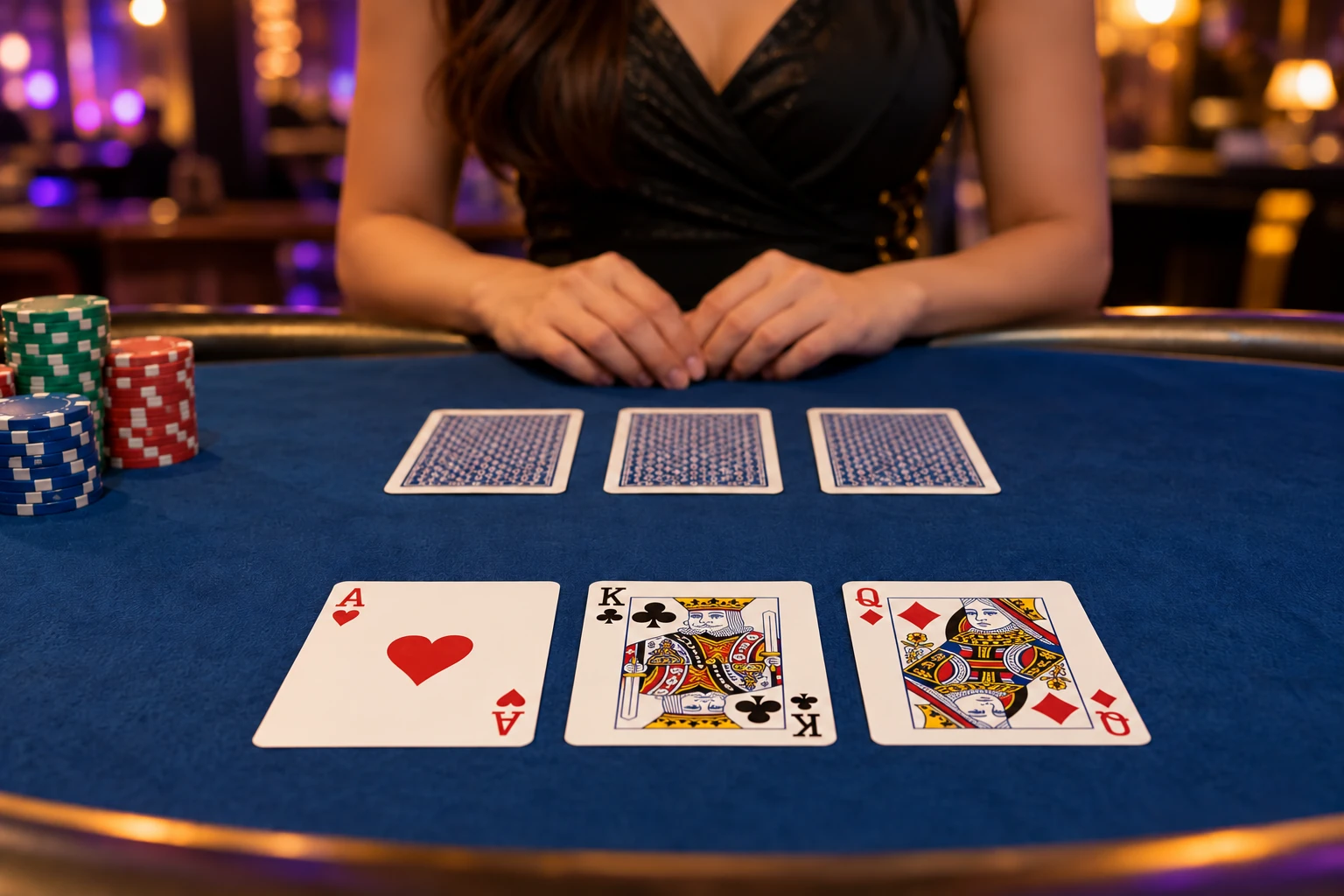
A dealer Teen Patti table carries its own kind of theatre. Three cards are laid face up in front of the player while the dealer’s three cards sit face down. The round holds at a decision point, then the dealer cards turn over. That sequence gives the dealer-versus-player format a shape you can follow from the first card to the last.
The version discussed here is Evolution’s dealer-versus-player Teen Patti, used as an external mechanism example. Availability on Slotrave is unconfirmed. Its rules belong to that particular version, so they should not be read as identical to traditional player-versus-player Teen Patti or to card play at home. The source page is linked below for readers who want the maker’s own description.
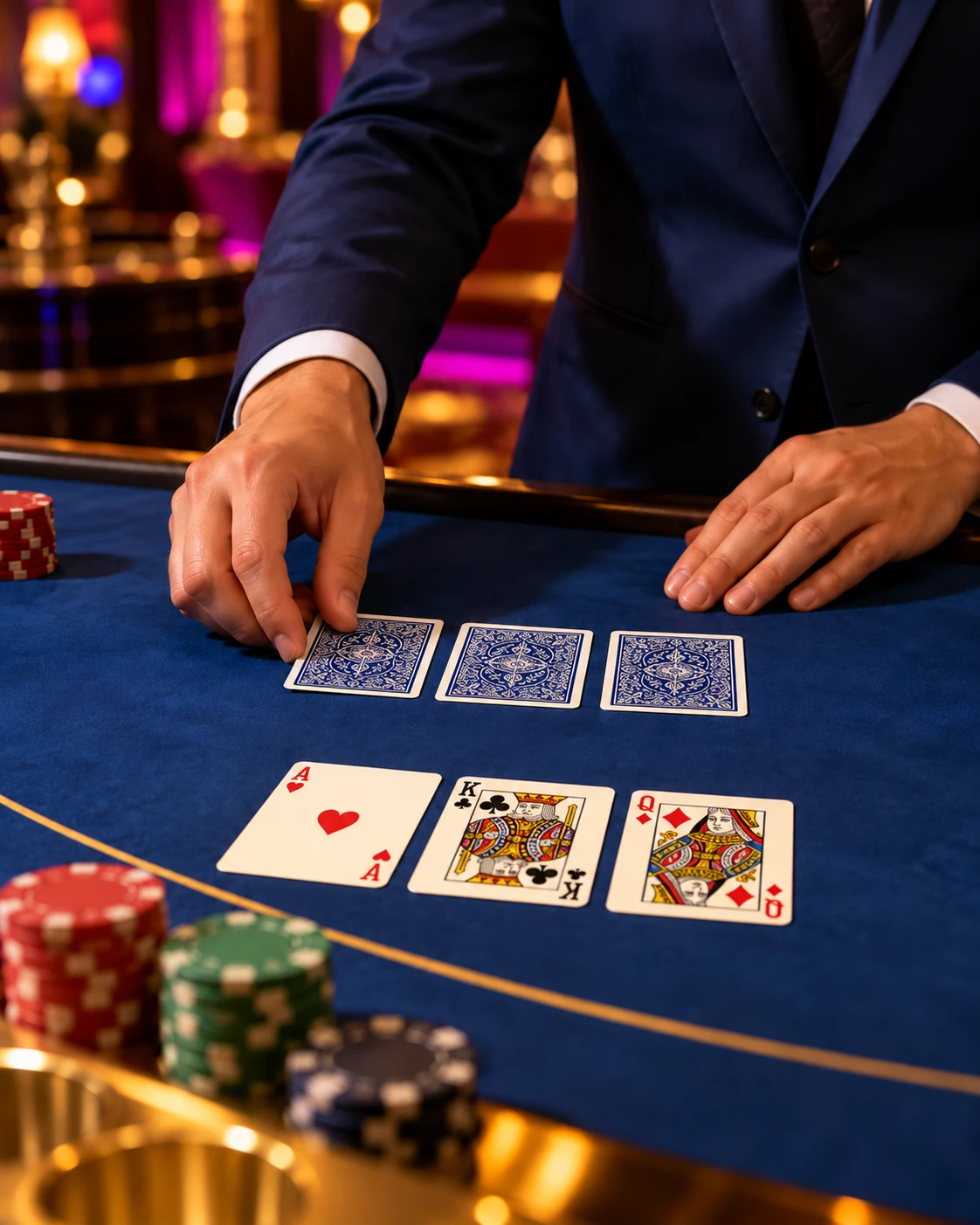
Three cards shown and three cards concealed
The table presents a live dealer and a card area. The player receives three cards face up, and the dealer receives three cards face down. The deal is the first visual phase of the round. The player can read the full three-card hand at once, while the dealer’s hand stays hidden until the reveal.
The second phase is the action stage, where the player continues or folds. The third phase is the reveal, when the dealer cards are turned over and the qualification check follows. The fourth is settlement, which applies the version’s payment rules. Reading the round as these four phases keeps the visible cards, the personal decision and the outcome in clear order.
The two card areas carry most of the visual weight. On the player side, all three cards are readable straight away. On the dealer side, the card backs hold the suspense until the round resolves. The table does not add further draws after the initial deal, so the three cards you see and the three you wait for are the whole hand.
The Ante opens the round
An Ante wager is placed before the deal. That ordering matters, because the commitment exists before any card is visible. The dealer then deals the player three face-up cards and keeps three face-down cards for the house. The Ante sits as the entry stake of the hand.
The main game has two wager points: the Ante before the deal and an optional Play wager after the cards are seen. Fold is an action rather than a third wager. Choosing to fold ends the hand and forfeits the Ante already placed. The round therefore builds from an entry stake, moves through a decision, and settles against the dealer hand.
The visible side of the table belongs to the player’s own three cards, dealt face up, while the dealer’s three cards stay face down until the reveal. That single contrast carries the round: an open hand on one side and a concealed hand on the other. Everything between the deal and the reveal happens in the space that contrast creates.
The pause between Play and Fold
After viewing the three cards, the player decides whether to continue. Continuing requires a Play wager equal to the Ante. Folding gives up the Ante and ends the hand without a comparison. There is no middle path and no additional draw, so the choice is direct.
The pause between the deal and that choice is where the format gains its character. Play adds a second amount equal to the Ante already at stake. Fold closes the main hand and forfeits the Ante. The player makes one decision with the cards in view, and the round moves on from there.
That equality between Ante and Play is a structural feature of the version. It keeps the two wager amounts paired. The player who continues has two matching amounts at stake, and the player who folds has one amount already committed. This is the decision point that defines the round.
Why the dealer needs Queen High
Qualification is a specific rule of this dealer version. The dealer hand must reach Queen High or better for the hand comparison to proceed. Queen High is the threshold that separates a qualifying dealer hand from a non-qualifying one, and the settlement of the Play wager depends on which side of that line the dealer falls.
When the dealer qualifies, the two three-card hands are compared directly. The higher player hand pays both the Ante and the Play wager at 1:1. A higher dealer hand takes both stakes. Equal hands push, meaning the wagers are returned. These three outcomes cover qualifying hands.
When the dealer does not qualify, the Play wager is returned and the Ante pays 1:1. The qualification check therefore changes how the second wager settles without changing the entry stake. The rule applies to the dealer’s hand alone, and the Queen High boundary is fixed by the version rather than by the player’s cards.
How the main wagers settle
Settlement follows the qualification result. If the dealer fails to qualify, the Play stake comes back and the Ante pays at 1:1. If the dealer qualifies, the comparison decides the hand. A higher player hand returns both stakes with 1:1 payment on each. A higher dealer hand means both stakes are lost. An equal hand pushes both back.
Following the money through the round is straightforward once the stages are separated. The Ante is committed at the start. The Play wager is added only on the continue decision. The dealer’s qualification determines whether the Play wager is even compared, and the hand comparison determines the final outcome when it is.
Teen Patti’s three-card comparison also sits beside other Indian card tables. Those who enjoy a different card rhythm can look at Andar Bahar at the card table, where the tension comes from matching a reference card on one of two sides. The dealer Teen Patti round keeps its own three-card hand and qualification rule.
Optional bets with their own result
Two optional side bets sit alongside the main Ante and Play flow. Pair Plus looks only at the player’s three cards and requires a pair or better to pay. The 6 Card Bonus combines the player’s three cards with the dealer’s three cards to form a five-card poker hand, with its payout table shown in the game. Neither bet is needed to play the main hand.
Keeping the side bets separate from the main wager keeps the round legible. The Ante and Play settle through qualification and hand comparison. Pair Plus settles on the player’s cards alone. The 6 Card Bonus settles on the combined six cards. Each has its own condition and its own result.
The reveal is the moment these separate results arrive together. The dealer cards come over, the qualification check is applied, the main hand is compared, and any side bet is read against its own condition. One reveal, several outcomes, all resolved from the same six cards.
The live-table rhythm on a smaller screen
The round’s visual logic suits a compact layout when the arrangement keeps the two card areas distinct. Three player cards face up, three dealer cards face down, and the Ante and Play amounts near the action controls form the core of the screen. On a smaller display, the exposed player hand should be the first thing readable, because that hand drives the continue-or-fold decision.
Slotrave is an India-friendly casino with INR support and deposits through UPI and Paytm. It also supports mobile play on Slotrave, so players can open live tables without a desktop layout. Whether a particular dealer table is offered there remains unconfirmed, and the general point holds for any live table viewed on a phone: the player cards and the dealer cards must stay visually separate.
Rupee stakes keep the Ante and the equal Play wager easy to compare when both appear on screen. On a phone, a table serves the round best when the player cards, the concealed dealer area and the action controls each read as their own zone.
A three-card game among Indian casino favourites
Teen Patti holds a familiar place among Indian card games, and the dealer version keeps the three-card comparison while moving the contest to a single opponent. Slotrave carries slots, live casino, Teen Patti, Andar Bahar and Rummy, so the card tables sit beside reels-based play. Readers who want the reel side of the floor can visit Slotrave slots and feature rounds for that different rhythm.
A slot round turns reels and may trigger features. A dealer Teen Patti round deals once, offers a continue-or-fold decision, then reveals. The appeal of the card table lies in that fixed sequence and in the equal Ante and Play structure, with Queen High as the dealer’s qualification line.
In brief: an Ante opens the hand before the deal, three player cards come face up and the dealer holds three face down, then the player adds an equal Play wager or folds. The dealer needs Queen High or better. A higher player hand has Ante and Play pay 1:1, a higher dealer hand loses both, equal hands push, and a non-qualifying dealer returns Play while the Ante pays 1:1. Pair Plus and 6 Card Bonus remain separate optional bets.
Everything here follows the Evolution dealer-versus-player version described above and should not be applied to traditional Teen Patti variants. The game is intended for adults aged 18 and over. Terms and conditions apply.